
In an era where digital transformation is reshaping how businesses operate, Malaysia’s Lembaga Hasil Dalam Negeri (LHDN) is taking a significant step forward with its e-Invoicing initiative. Designed to streamline tax compliance, enhance transparency, and reduce administrative burdens, the e-Invoicing framework represents a major shift from traditional invoicing practices to a real-time, standardised digital system.
The nationwide rollout is being implemented in phases, targeting different taxpayer categories based on annual turnover. According to the latest updates, the final phase of mandatory implementation, covering businesses with annual turnover between RM1 million and RM5 million will take effect on 1 January 2027. This marks the completion of Malaysia’s full transition to a nationwide e-Invoicing ecosystem.
Relying on manual invoicing or disconnected systems can lead to delayed billing, documentation errors, and uncertainty regarding compliance with Malaysia’s e-Invoicing policies. As a result, a structured medical invoice management system has become essential for clinics seeking to remain compliant, organised, and operationally efficient.
Let’s take a closer look at the most common e-invoicing challenges medical clinics face today, followed by how the right system can help overcome them.

Some medical clinics still rely on handwritten invoices, spreadsheets, or standalone billing systems that are not integrated with patient records. This often results in duplicated work, inconsistent information, and delays in issuing e-invoices after consultations or treatments.
When billing data is disconnected from clinical records, staff must repeatedly verify patient details, services provided, and charges. This not only increases the risk of errors but also slows down daily operations
With the implementation of e-Invoicing by LHDN, clinics are required to issue e-invoices that meet specific formatting and submission standards through the MyInvois portal. For many clinics, understanding these requirements and ensuring full compliance can be both complex and time-consuming.
Without a proper system in place, clinics may struggle to prepare compliant e-invoices, leading to submission errors or delays that impact clinic operations.
Manual data entry increases the likelihood of incorrect patient information, service descriptions, or billing amounts. Even minor inaccuracies can cause invoices to be rejected, requiring rework and additional administrative follow-up.
These errors not only delay payments but also place unnecessary strain on clinic staff.
Preparing invoices, verifying details, submitting them manually, and tracking their status takes valuable time. In busy clinics, this means doctors and staff spend less time focusing on patients and more time handling paperwork.
As patient volumes increase, this administrative burden grows, affecting productivity and workflow efficiency.
Without a centralised system, clinics may struggle to track whether invoices have been submitted, approved, or rejected. This lack of visibility can lead to compliance risks, reporting inaccuracies and operational inefficiencies.
Read More: Understanding e-Invoicing for Primary and Specialist Clinics: Benefits and Insights

The best medical invoice management system integrates billing directly into clinic operations, eliminating the need for duplicate data entry. Patient details and services provided are accurately reflected in e-Invoices, allowing clinics to generate them efficiently and consistently.
This reduces administrative workload and helps clinics operate more smoothly.
The right system supports Malaysia’s e-Invoicing requirements by generating e-Invoices in the correct format and enabling direct submission to LHDN MyInvois Portal. This eliminates uncertainty around compliance and ensures clinics meet regulatory standards with confidence.
Automated e-Invoice generation minimises manual data entry, significantly lowering the risk of human errors. With accurate information captured from the outset, clinics experience fewer rejected invoices and faster processing times.

By simplifying e-Invoice creation, submission, and tracking within a single system, clinics can manage the entire e-Invoicing process more accurately and efficiently without switching between multiple platforms or relying on manual workflows.
The best medical invoice management system frees up staff time. Instead of managing paperwork, teams can focus on patient care and enhancing the overall clinic experience.
The best medical invoice management system allows clinics to monitor e-Invoice status in real time, from submission to approval, all within the same system, without relying on third-party tools. This end-to-end visibility helps clinics to identify pending e-Invoices promptly, reduce follow-up delays, and maintain better control over their revenue recognition and financial operations.
Read More: 5 Facts That Show How e-Invoicing Simplifies Medical Invoices for Clinics
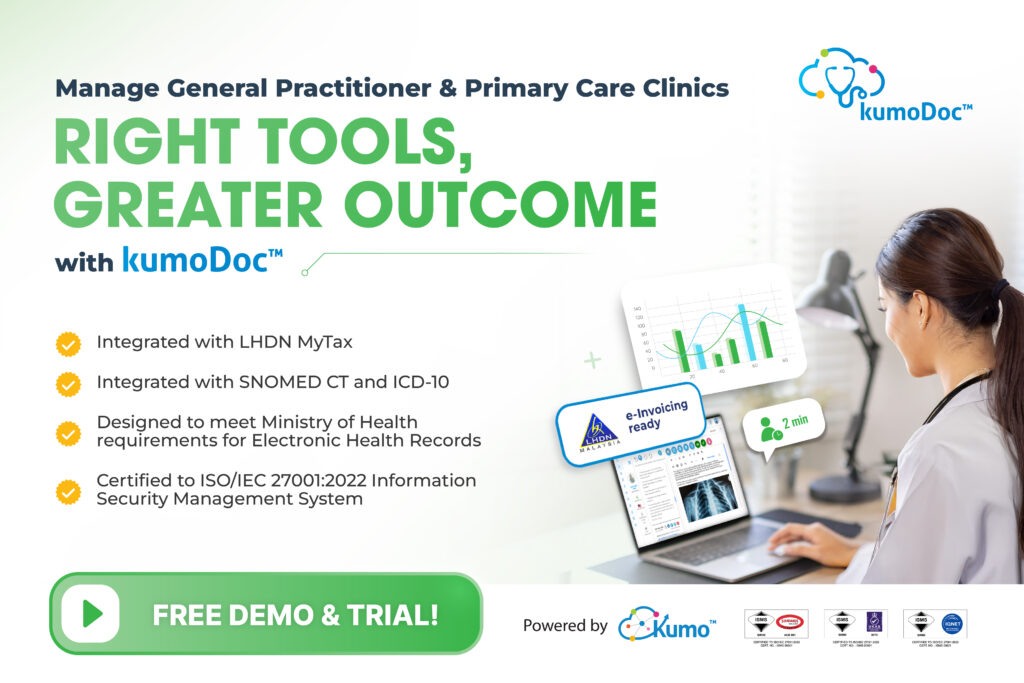
As e-Invoicing becomes a standard requirement in Malaysia, primary and specialist care clinics need solutions that go beyond basic billing. A reliable medical e-Invoice management system helps clinics stay compliant, reduce errors, and streamline daily operations while supporting better patient care.
Designed specifically for medical clinics, kumoDoc™ offers a comprehensive solution to help clinics manage e-Invoices efficiently, maintain regulatory compliance, and enhance operational performance. Continuously updated to align with evolving requirements, kumoDoc™ empowers clinics to adapt confidently while remaining focused on what matters most delivering quality care to patients.
Book a FREE demo today or contact us to discover how kumoDoc™ can simplify medical e-Invoicing and support your clinic’s long-term growth.





 English
 B. Malaysia
 Chinese
 B. Indonesia
 Thai
Thai